In this, my 70th blog post, I'd like to report on a sad state of affairs: I'm having a media meltdown of sorts.
Television has never been my babysitter. I have always been one to prefer a good book over the idiot box or its cooler younger sister, the internet. Oftentimes I'd rather stare at the ceiling listening to music and watching the pictures in my imagination.
Things changed when I moved to Istanbul. I got cable and I generally eat dinner in front of CNN international or E! I can hardly walk away from my laptop and into the next room without rushing to check my email upon my return. I wake up wondering if anyone has emailed me, and I often feel deflated when all my inbox contains is the NYT book update and a reminder to pay my student loans. I've even cried tears of anger over the lack of contact. And yes, on occasion I will even watch The Hills. It’s become a reflex, a need for perpetual contact. I justified my excessive (for me) internet and television usage as a necessary means of keeping up with global news while living abroad; a coping mechanism in a foreign country. However, I must come clean. It seems that I am no better than the other Twitterati whose ever existence is predicated on the fact that they say things, and others are forced to listen. Let's face it. I'd be the same anywhere in the world.
I have a blog and a website; I'm on Facebook and Twitter. I am no longer elusive and mysterious (if I ever was).Unfortunately, I find myself wanting to write numerous versions of a status that involves sitting in front of the computer searching for something of substance, realizing its becoming harder and harder to find.
I know, it’s not like I'm shooting up heroin, but there are side effects: I write less in my journal. I read fewer actual books. I question the very existence of journalism. I wonder if English Lit will be obsolete in a few years. And the information I so prolifically produce? It all just goes into the endless vaacuum of cyberspace, where one cannot see it in its entirety. I never know if it gets noticed, much less read. I never know if I achieve my purpose: to connect.
I've often felt I'm just not cut to be the media savvy type: I write and think slowly so that by the time I finish a post the moment has grown stale. My thoughts go sour before they go public. Nor am I okay with putting anything - a chirp, a status update, a banal blog entry - out in the universe without a bit of polish. I know spelling errors or inane comments followed by "oops, I take it back, that was my subconscious talking" have become socially acceptable, but they seem like attention seeking cop-outs. I like to pretend I'm at an old-fashioned typewriter; no mistakes or I have to start over. No cut and pastes. I don't like to be pseudo-raw on paper. I believe rawness comes not from just putting it all out there for others to sort through, but whittling it all away to the bare bones so readers have nothing left to pick at - just the truth. The latter takes more work. The formal is the literary equivalent of cringe worthy reality television. Call me a literary snob, but I refuse to prostitute language or stop striving for eloquent prose.
And yet, as a writer, unless I want to go the way of the dinosaur, I must evolve along with the rest of the world.
There are pros: there is a certain intimacy in self-publishing; there is no filter, no guarantee that anyone will ever read it. Freedom comes with anonymity. I don't think I will ever want to share everything; I don't care to tell you that I'm really worried the crown on my back molar is going to fall off and I will have to go to a dentist. I don't want to create a cutesy persona where I talk only about the perils of dating or every item I've consumed today and my caloric intake; and yet, it is these details, these images that attract and keep an audience, and I recognize that the internet is a sort of invisible stage. This begs the question: am I just another narcissistic wannabe using the internet as my personal sounding board? I guess I will let you (if you exist) decide for yourself.
Saturday, February 28, 2009

Sunday, February 8, 2009
Down Kopek
I find it hard to believe that revisiting yoga has taken me so long. Perhaps halting a practice that I love for over a year has to do with the fact that I still maintan a certain allegiance to Bikram's and Brian Kest's power yoga in Chicago and Los Angeles, respetively. I associate the intensity of Sunday morning power yoga with a particular LA lifestyle that seems incomplete without organic brunch, acting classes or a day at the beach; the sweltering sauna of Bikram's will forever be bound to a particularly frigid Chicago February. Although I had a yoga resurgance over the summer and I resolved to find a good studio upon returning to Istanbul, it still took me six more months to kick myself into gear. Yoga - or for that matter, any semblance of a spiritual life - seems to have no place here. It is part of a past world I no longer inhabit. Or perhaps I was hesitant to pursue yoga for the same reasons I flinch at the prospect of doing anything new in Istanbul: fear of getting lost, a long commute, being unable to communicate my needs or just merely not wanting to go at it alone.
My inculcation into the world of yoga was accidential. After college, I randomly ended up living mere blocks from one of the most renowed studios in LA. Despite its location in exclusive Santa Monica, the course was donation based. I usually submitted far below the suggested 10 dollars. The proximity and price is what allowed me to practice consistently, albeit briefly. Only after I began practicing did I discover that my yoga studio was was considered to be the epicenter of the American yoga movement, popular long before it became trendy throughout the United States.
From day one, the yoga aesthetic intrigued me: the streamlined poses, the sculpted bodies, the potent smell of jasmine or sage as you entered the studio, the fluid sanskrit jargon of the practice, the willowy frequent practioners who all took on that same elongated, gamine look regardless of ethnic origins. It all spoke of a higher consciousness, of potential transcendence of the pedestrian plane of existance I inhabited.
Early on, I recognized that yoga, like any other activity, came with its very own "scene" defined by a particular aesthetic and a set of subtle social codes. I also recognized that I sorely lacked the necessary accoutrements to fit in: nalgene water bottles, lower back tattoos, lululemon designer yoga attire, a certain air of self-satisfaction or contentment, and comradiere with everyone who entered the studio were beyond my grasp. I wondered what I often wondered while living in LA - if I was only projecting my inscurities, and perhaps it was everyone else felt like a phony and looked to me as an example of the real McCoy. I somewhat resented my fellow classmates, whom I figured had to do yoga and shop at Whole Foods for a living to get those bodies. They had the time and money to invest in the legnthy process of self-actualization, the common folk who have to work for a living simply can't afford to sacrifice their livlihood for pruning and shaping their spirits. Why didn't I float through the air like my fellow yogis? I guess I was just too stressed out. I came to love the practice but hate the scene.
I still maintain that yoga is one of the best things I've ever done for myself. Yoga - whether in Istanbul, Chicago or LA - still does it for me: it makes me feel strong, flexible and a more comfortable inhabitant in my own body. It was still yoga, but slightly different - my first time doing yoga led by a man speaking "Turklish" with an Irish brogue, my first time looking out over the Bosphorus while practicing, first time where a free sauna is available after my practice. My reintroduction to yoga has left me feeling slightly exhaused and sore, but perhaps one step closer to whatever it is I still seek from the practice.
My inculcation into the world of yoga was accidential. After college, I randomly ended up living mere blocks from one of the most renowed studios in LA. Despite its location in exclusive Santa Monica, the course was donation based. I usually submitted far below the suggested 10 dollars. The proximity and price is what allowed me to practice consistently, albeit briefly. Only after I began practicing did I discover that my yoga studio was was considered to be the epicenter of the American yoga movement, popular long before it became trendy throughout the United States.
From day one, the yoga aesthetic intrigued me: the streamlined poses, the sculpted bodies, the potent smell of jasmine or sage as you entered the studio, the fluid sanskrit jargon of the practice, the willowy frequent practioners who all took on that same elongated, gamine look regardless of ethnic origins. It all spoke of a higher consciousness, of potential transcendence of the pedestrian plane of existance I inhabited.
Early on, I recognized that yoga, like any other activity, came with its very own "scene" defined by a particular aesthetic and a set of subtle social codes. I also recognized that I sorely lacked the necessary accoutrements to fit in: nalgene water bottles, lower back tattoos, lululemon designer yoga attire, a certain air of self-satisfaction or contentment, and comradiere with everyone who entered the studio were beyond my grasp. I wondered what I often wondered while living in LA - if I was only projecting my inscurities, and perhaps it was everyone else felt like a phony and looked to me as an example of the real McCoy. I somewhat resented my fellow classmates, whom I figured had to do yoga and shop at Whole Foods for a living to get those bodies. They had the time and money to invest in the legnthy process of self-actualization, the common folk who have to work for a living simply can't afford to sacrifice their livlihood for pruning and shaping their spirits. Why didn't I float through the air like my fellow yogis? I guess I was just too stressed out. I came to love the practice but hate the scene.
I still maintain that yoga is one of the best things I've ever done for myself. Yoga - whether in Istanbul, Chicago or LA - still does it for me: it makes me feel strong, flexible and a more comfortable inhabitant in my own body. It was still yoga, but slightly different - my first time doing yoga led by a man speaking "Turklish" with an Irish brogue, my first time looking out over the Bosphorus while practicing, first time where a free sauna is available after my practice. My reintroduction to yoga has left me feeling slightly exhaused and sore, but perhaps one step closer to whatever it is I still seek from the practice.
Sunday, January 18, 2009
Goop
Day One:
rice milk smoothie
salad with carrot ginger dressing
avocado and cucumber soup (delicious)
Forget therapy, codependent relationships or hitting the sauce. When it comes to dealing with irreconcilable issues, I've opted for detox as my coping mechanism of choice. I'm talking good old-fashioned catharsis and denial. (Don't worry, no colonics, enemas, or prescription medications were used in this process.)
No one knows how to detox better than overexposed celebrities, so I headed to ground zero: Gwenyth's Paltrow's website, www.goop.com. Gwennie offered an entire weeks menu complete with recipes for those who want to shed some post-holiday pounds and get that extreme self-discipline high that kind of feels like vertigo.
Gwen: I love detoxing. Its an essential part of a balanced, nuturing, self-aware, socially conscious, artsy-fartsy, Anglophile macrobiotic lifestyle.
Me: Yes, but do you really need to have a "Be" link on your site? Are you qualified to tell me how to exist?
Gwen: Yes. I've lived in another culture, you know.
Me: Do you really think London is a different culture? Is this what you teach your daughter Apple? And how come the name Peaches sounds saucy but Apple sounds so wholesome? I mean, they're both fruits and all.
Gwen: Um..
Okay, that conversation never actually happened. I expect miracles when I detox, such as glowing skin, mental equnamity and a perfect body. Maybe the remnants of all those corned beef sandwiches and peanut butter cups I ate as a child will be flushed out of my system once and for all. In truth, my objectives run deeper. I am determined to get in touch with my inner goop.
******
If you've ever done a detox, you know that it is primarily a metal affair. Subconsciously, I think a part of me believes that the secrets of the universe will reveal themselves to me if I cut dairy and carbs out of my diet. I'm seeking an abstract, life alterning epiphany in a very physical change. After all, the great Buddha said that desire is the root of all suffering.
In any sort of denial, one must cultivate a different relationship with the self. Detoxing is an anecdote to the gluttony that epitomizes modern society, and by extension, an overstimulated self.
A detox has some obvious defining characteristics (you eat less) and some subtle ones (you poop more). There is also an easing into the self and a stripping away of inesentials that is both powerful and frightening. That I cannot quite explain, but consider this: holiness is often aligned with the denial of food: think Ghandi, and all those religious fasts and restrictions, and the way our society idealizes and often lauds anorexia, or merely those who have the willpower to maintain thinness. Thinness is a manifestation of what we truly covet: mastery of, and control over the self.
Day Two:
Fresh carrot orange juice
Broccoli and Basil soup
Steamed salmon and veggies
www.goop.com
rice milk smoothie
salad with carrot ginger dressing
avocado and cucumber soup (delicious)
Forget therapy, codependent relationships or hitting the sauce. When it comes to dealing with irreconcilable issues, I've opted for detox as my coping mechanism of choice. I'm talking good old-fashioned catharsis and denial. (Don't worry, no colonics, enemas, or prescription medications were used in this process.)
No one knows how to detox better than overexposed celebrities, so I headed to ground zero: Gwenyth's Paltrow's website, www.goop.com. Gwennie offered an entire weeks menu complete with recipes for those who want to shed some post-holiday pounds and get that extreme self-discipline high that kind of feels like vertigo.
Gwen: I love detoxing. Its an essential part of a balanced, nuturing, self-aware, socially conscious, artsy-fartsy, Anglophile macrobiotic lifestyle.
Me: Yes, but do you really need to have a "Be" link on your site? Are you qualified to tell me how to exist?
Gwen: Yes. I've lived in another culture, you know.
Me: Do you really think London is a different culture? Is this what you teach your daughter Apple? And how come the name Peaches sounds saucy but Apple sounds so wholesome? I mean, they're both fruits and all.
Gwen: Um..
Okay, that conversation never actually happened. I expect miracles when I detox, such as glowing skin, mental equnamity and a perfect body. Maybe the remnants of all those corned beef sandwiches and peanut butter cups I ate as a child will be flushed out of my system once and for all. In truth, my objectives run deeper. I am determined to get in touch with my inner goop.
******
If you've ever done a detox, you know that it is primarily a metal affair. Subconsciously, I think a part of me believes that the secrets of the universe will reveal themselves to me if I cut dairy and carbs out of my diet. I'm seeking an abstract, life alterning epiphany in a very physical change. After all, the great Buddha said that desire is the root of all suffering.
In any sort of denial, one must cultivate a different relationship with the self. Detoxing is an anecdote to the gluttony that epitomizes modern society, and by extension, an overstimulated self.
A detox has some obvious defining characteristics (you eat less) and some subtle ones (you poop more). There is also an easing into the self and a stripping away of inesentials that is both powerful and frightening. That I cannot quite explain, but consider this: holiness is often aligned with the denial of food: think Ghandi, and all those religious fasts and restrictions, and the way our society idealizes and often lauds anorexia, or merely those who have the willpower to maintain thinness. Thinness is a manifestation of what we truly covet: mastery of, and control over the self.
Day Two:
Fresh carrot orange juice
Broccoli and Basil soup
Steamed salmon and veggies
www.goop.com
Sunday, January 11, 2009
Channeling Maria Elena
Call me sappy and neurotic, but I was particularly moved by Woody Allen's Vicky Christina Barcelona.
"It will always be romantic because it will never be complete." This line got stuck on repeat in my head, and I spent much of the movie debating its validity with the actors on screen. If romance derives from longing, unfulfilled passion and the intrigue of the unknown, then romance will forever be attributed to the one that got away, not the one you are with. All at once, Allen seems to affirm and debunk the myths about love and romance that Hollywood loves to perpetuate: love is eternal but transient, the one is out there, but love and attraction follow no rhyme or reason, love's tenderness is intricately tied with its brutality. These things we know about love's Gemini nature; we have yet to figure out how to deal with them. They were meant to be and they were not meant to be, he loves her and hates her, can't they just live happily ever after already? But I'm glad they don't. I can't tell who I feel for more; the woman whose dissatisfaction comes from never being satisfied or the woman whose discontent stems from the fact that she settled.
And then came Maria Elena: her wild gesticulating, historonics and emotionality seemed all too familiar. I was glad to see a character that acted like I have often felt. Granted, I have never taken a gun to anyone, but the notion that love can and does make a person do irrational things must be affirmed. If anything, perhaps I will stop trying to quell my inner Maria Elena. Life seems a lot more interesting that way.
I’ve lost my taste for romantic comedies over the past few years, and while I'd like to get swept away in epic love stories, they only succeed in whipping up a mental backlash of reality to neutralize the romance. Perhaps that is why I appreciate it so much when art speaks the truth: that love often brings us more misery than joy, that romance and marriage mix like oil and water, and that, although it might be a gross distortion, the extent of our suffering is often a litmus test for the authenticity of our passion.
So who knows? With any luck, maybe someday I’ll end up a disarming Spaniard’s emotionally unstable ex-lover or married to a dial tone of a man who is totally predictable and just plain fine. Maybe in another life, I will be a sultry Spanish woman in a love/hate relationship with Javier Bardem. Or perhaps I will remain perpetually unsatisfied, certain only of what I do not want.
I suppose one thing is for certain. In the movie, the characters are neither here nor their, constantly torn asunder between logic and emotional, heart and head. Life moves on and the summer ends, but Woody likes to keep reminding us that life offers no resolution at all.
"It will always be romantic because it will never be complete." This line got stuck on repeat in my head, and I spent much of the movie debating its validity with the actors on screen. If romance derives from longing, unfulfilled passion and the intrigue of the unknown, then romance will forever be attributed to the one that got away, not the one you are with. All at once, Allen seems to affirm and debunk the myths about love and romance that Hollywood loves to perpetuate: love is eternal but transient, the one is out there, but love and attraction follow no rhyme or reason, love's tenderness is intricately tied with its brutality. These things we know about love's Gemini nature; we have yet to figure out how to deal with them. They were meant to be and they were not meant to be, he loves her and hates her, can't they just live happily ever after already? But I'm glad they don't. I can't tell who I feel for more; the woman whose dissatisfaction comes from never being satisfied or the woman whose discontent stems from the fact that she settled.
And then came Maria Elena: her wild gesticulating, historonics and emotionality seemed all too familiar. I was glad to see a character that acted like I have often felt. Granted, I have never taken a gun to anyone, but the notion that love can and does make a person do irrational things must be affirmed. If anything, perhaps I will stop trying to quell my inner Maria Elena. Life seems a lot more interesting that way.
I’ve lost my taste for romantic comedies over the past few years, and while I'd like to get swept away in epic love stories, they only succeed in whipping up a mental backlash of reality to neutralize the romance. Perhaps that is why I appreciate it so much when art speaks the truth: that love often brings us more misery than joy, that romance and marriage mix like oil and water, and that, although it might be a gross distortion, the extent of our suffering is often a litmus test for the authenticity of our passion.
So who knows? With any luck, maybe someday I’ll end up a disarming Spaniard’s emotionally unstable ex-lover or married to a dial tone of a man who is totally predictable and just plain fine. Maybe in another life, I will be a sultry Spanish woman in a love/hate relationship with Javier Bardem. Or perhaps I will remain perpetually unsatisfied, certain only of what I do not want.
I suppose one thing is for certain. In the movie, the characters are neither here nor their, constantly torn asunder between logic and emotional, heart and head. Life moves on and the summer ends, but Woody likes to keep reminding us that life offers no resolution at all.
Tuesday, January 6, 2009
Gaza
I don’t need to reiterate the facts about the situation in Gaza. If you've been paying any attention to the news, no matter what station or side you adhere to, one thing is for certain: there is a full-blown crisis that only appears to be getting worse. What I do need is to process the why of it all.
I can look at the situation as a bloody massacare: a disporportionate retaliation, the death of innocent civilians and unnecessary collateral damage, the anger and frustration of the Palestinian people a natural outgrowth of a population recovering from an occupation followed by a strict embargo, Israel's blatant defiance of global pleas for a cease fire and misguided attempt at achieving its objective of ending quassam rocket fire and rooting out a terrorist faction with force that is backed by Iran and deeply intertwined with Palestine, the ensuing humanitarian crisis - all horrific.
I can see the situation as a necessary means of self-defense on Israel's part: a country that waited for eight years to act against rocket fire and now wants to defend itself against Hamas after they ignored a cease fire and targeted civilians, a group that uses dead Palestinians as sympathy and women and children as human shields, that preaches hatred against Jews and rejects Israel’s right to exist.
I could say that fighting until "the bitter end" is a testament to Israel's tenacity and persistence, or its stubbornness and pride. I could say that airstrikes are necessary, or they will only ignite anger and create an excuse for further aggression that only serves to entrench each side in the their deeply ingrained positons.
I could ask pointed questions to both sides: Why is it so hard for a Palestinian mothter to cross the boarder to be with the children she hasn’t seen in eight years? Why would Hamas smuggle weapons and launch rockets, well knowing that doing so would endanger boarders as conduits of food and aid to the Palestinians? Why, according to the Facebook videos from my friends, must Israeli Kindergardeners live in fear, and why must Palestinians who take refuge in schools be attacked? Why do we say people go to war to die but not to kill? I wonder, and then I remind myself that war, by its very nature, is brutal and immoral.
But amidst all the bloodshed and between all the perspectives, I mostly see the same things: politicians who give the same old party lines, an impotent UN Security Council, a Secretary of State who wanted to make peace in the Middle East her legacy and who will now have to settle for a patchwork diplomacy, and two sides that define themselves so much upon being embroiled in battle that their hatred for the other defines their existence as much as the protection of their people.
I could assert that I know about the situation because I read the papers and watch to the news; I listen to the conservatives and the liberals, the Muslims and the Jews. I could say I know nothing because I am not there, living it. I could say that Palestinians recieved text message in Arabic stating that they shouldn’t be near any weapons storehouses and the Israelis have done what they can to prevent civilian casualities, or they have done nothing at all. However, I am not sure that tragic civilian deaths halted bombings in Dresden, Hiroshima or Vietnam.
In the end, I watch the conflicts on the news with the same horrified detachment as most people: how atrocious, I think, how sad, they are still fighting over and over and over, and then I return to my comfortable, sheltered life, where I don’t have to take a stand, much less put my life on the line. I have the luxury, as do most of the pundits, opinions writers, and so-called experts, of sitting back and analyzing, thinking, mulling it over and refraining from being partisan. Yet in this case, I feel the jittery anxiety as if something personally disasterous beyond my control were about to happen, and I was unable to do anything about it.
I can only conclude that no matter how well informed I may be, I will never get to the truth of the matter. That somehow, in the minds of those who are shooting rockets and dropping bombs, the rest of the world simply doesn’t understand. I see that in the frustration of those being interviewed on both sides of a 20x4 mile strip of land and in the anger of people throwing rocks and assessing damage. I can’t understand the cycle of violence, the stale rhetoric, the tit for tat retaliations, the escalating offensives and the anger.
I can repeat contradictory truisms: violence is never the answer, violence is a necessary evil in order to achieve peace, violence only begets violence, an eye for an eye, turn the other cheek. I do not know what it is like to be so adamant in your opinions or to identify with one aspect of your identity so strongly that you will sacrifice everything for your nation or religion. I only fear, that with anything so intense, be it two nations or two individuals, love or hate, it won’t end when others try to extinguish it, but only when it burns itself out.
I can look at the situation as a bloody massacare: a disporportionate retaliation, the death of innocent civilians and unnecessary collateral damage, the anger and frustration of the Palestinian people a natural outgrowth of a population recovering from an occupation followed by a strict embargo, Israel's blatant defiance of global pleas for a cease fire and misguided attempt at achieving its objective of ending quassam rocket fire and rooting out a terrorist faction with force that is backed by Iran and deeply intertwined with Palestine, the ensuing humanitarian crisis - all horrific.
I can see the situation as a necessary means of self-defense on Israel's part: a country that waited for eight years to act against rocket fire and now wants to defend itself against Hamas after they ignored a cease fire and targeted civilians, a group that uses dead Palestinians as sympathy and women and children as human shields, that preaches hatred against Jews and rejects Israel’s right to exist.
I could say that fighting until "the bitter end" is a testament to Israel's tenacity and persistence, or its stubbornness and pride. I could say that airstrikes are necessary, or they will only ignite anger and create an excuse for further aggression that only serves to entrench each side in the their deeply ingrained positons.
I could ask pointed questions to both sides: Why is it so hard for a Palestinian mothter to cross the boarder to be with the children she hasn’t seen in eight years? Why would Hamas smuggle weapons and launch rockets, well knowing that doing so would endanger boarders as conduits of food and aid to the Palestinians? Why, according to the Facebook videos from my friends, must Israeli Kindergardeners live in fear, and why must Palestinians who take refuge in schools be attacked? Why do we say people go to war to die but not to kill? I wonder, and then I remind myself that war, by its very nature, is brutal and immoral.
But amidst all the bloodshed and between all the perspectives, I mostly see the same things: politicians who give the same old party lines, an impotent UN Security Council, a Secretary of State who wanted to make peace in the Middle East her legacy and who will now have to settle for a patchwork diplomacy, and two sides that define themselves so much upon being embroiled in battle that their hatred for the other defines their existence as much as the protection of their people.
I could assert that I know about the situation because I read the papers and watch to the news; I listen to the conservatives and the liberals, the Muslims and the Jews. I could say I know nothing because I am not there, living it. I could say that Palestinians recieved text message in Arabic stating that they shouldn’t be near any weapons storehouses and the Israelis have done what they can to prevent civilian casualities, or they have done nothing at all. However, I am not sure that tragic civilian deaths halted bombings in Dresden, Hiroshima or Vietnam.
In the end, I watch the conflicts on the news with the same horrified detachment as most people: how atrocious, I think, how sad, they are still fighting over and over and over, and then I return to my comfortable, sheltered life, where I don’t have to take a stand, much less put my life on the line. I have the luxury, as do most of the pundits, opinions writers, and so-called experts, of sitting back and analyzing, thinking, mulling it over and refraining from being partisan. Yet in this case, I feel the jittery anxiety as if something personally disasterous beyond my control were about to happen, and I was unable to do anything about it.
I can only conclude that no matter how well informed I may be, I will never get to the truth of the matter. That somehow, in the minds of those who are shooting rockets and dropping bombs, the rest of the world simply doesn’t understand. I see that in the frustration of those being interviewed on both sides of a 20x4 mile strip of land and in the anger of people throwing rocks and assessing damage. I can’t understand the cycle of violence, the stale rhetoric, the tit for tat retaliations, the escalating offensives and the anger.
I can repeat contradictory truisms: violence is never the answer, violence is a necessary evil in order to achieve peace, violence only begets violence, an eye for an eye, turn the other cheek. I do not know what it is like to be so adamant in your opinions or to identify with one aspect of your identity so strongly that you will sacrifice everything for your nation or religion. I only fear, that with anything so intense, be it two nations or two individuals, love or hate, it won’t end when others try to extinguish it, but only when it burns itself out.
Thursday, January 1, 2009
New Years with Old People
An old woman cares for an even older woman in the apartment across the hall from me. They are both ill; the old one physically, the even older one mentally. Sometimes they sit out on their balcony while I sit on mine and we say hello.
The caretaker is from Georgia (the country, not the state), and because Turkish is not her mother tongue I can understand her quite well. She has an unsightly mole on her chin but her apartment is always spotless. The Georgian televion station is playing whenever I've been over there.
I brought over a dish of Turkish delight (actually called lokma), the fancy kind that you can get at the malls and that feels more like a marshmellow than the traditonal gummy squares you can find at corner stores. It was New Years Day and I did not feel like interacting with anyone, much less make forced conversation with a neighbor I don't know very well. Sometimes I think its better if you push yourself in odd ways, as though mustering the courage to talk to a benign woman across the hall will make me braver in the long run.
I knocked on the door and presented the dish of lokma while saying Happy New Year in my best Turkish. I'm quite sure I seemed friendlier than I felt. She made me sit and brought me a dish of asure, a Turkish pudding that contains the kitchen sink: raisins, various types of nuts, rice, this one even had corn nibblets in it. I forced a bit and said how delicious it was. Then she told me the old woman whom she carried for was dead. Actually, what she said was she's finished. I did wondered if she didn't know the Turkish word for dead or she assumed I didn't know it. She'd told me the same thing the last time I'd ran into her. For a moment I wondered if the old woman had died twice, and then I thought that langauge plays funny tricks on your mind.
I don't really have much to say. She didn't have cancer, she told me. I don't have cancer either, I thought, but saying it aloud woulnd't be funny. I stared at her mole. She talks at me, not to me, but I don't mind. I try to listen but instead I mentally compare my apartment to hers.
I wonder if I've stayed long enough and eaten enough to leave, as if the size of my of my bites and the number minutes I sit will determine the quality of my visit. Just as I am about to say I have to get going our downstairs neighbor knocks on the door. She talks quickly and seems to get frustrated with me easily. She proceeds in asking me questions via our Georgian neighbor (we don't know each others names but for some reason I don't think it matters). During the conversation I usually nod my head, and respond with the Turkish expressions for "really?" and "you don't say?" I don't use yes or no for fear of affirming or negating something I'm not quite sure of.
The Georgian asks me how old I am, and my other neighbor holds up fingers. The Georgian asks me why I don't get married, and my other neighbor repeats the word married and makes a gesutre of rubbing her ring finger, as if I am deaf or mentally retarded. The other woman holds up the number of fingers. I think about all the times I must use numbers in Turkish: when I ask for copies at school, when I pay for my groceries. I wonder if I am half-retarded.
I laugh and say I don't know. She asks me how long the flight is from here to Chicago, and I say 11 hours. She's asked me this question three times before. I think I must seem really boring.
They ask if another teacher will come when I leave, and I say I think so, but I don't know who. I heard the last teacher who lived in my apartment could only say merhaba. She was an older woman, and her husband died in my apartment. The Georgian woman told me this the first time she had me over. Sometimes I think its better to pretend I don't understand.
The caretaker is from Georgia (the country, not the state), and because Turkish is not her mother tongue I can understand her quite well. She has an unsightly mole on her chin but her apartment is always spotless. The Georgian televion station is playing whenever I've been over there.
I brought over a dish of Turkish delight (actually called lokma), the fancy kind that you can get at the malls and that feels more like a marshmellow than the traditonal gummy squares you can find at corner stores. It was New Years Day and I did not feel like interacting with anyone, much less make forced conversation with a neighbor I don't know very well. Sometimes I think its better if you push yourself in odd ways, as though mustering the courage to talk to a benign woman across the hall will make me braver in the long run.
I knocked on the door and presented the dish of lokma while saying Happy New Year in my best Turkish. I'm quite sure I seemed friendlier than I felt. She made me sit and brought me a dish of asure, a Turkish pudding that contains the kitchen sink: raisins, various types of nuts, rice, this one even had corn nibblets in it. I forced a bit and said how delicious it was. Then she told me the old woman whom she carried for was dead. Actually, what she said was she's finished. I did wondered if she didn't know the Turkish word for dead or she assumed I didn't know it. She'd told me the same thing the last time I'd ran into her. For a moment I wondered if the old woman had died twice, and then I thought that langauge plays funny tricks on your mind.
I don't really have much to say. She didn't have cancer, she told me. I don't have cancer either, I thought, but saying it aloud woulnd't be funny. I stared at her mole. She talks at me, not to me, but I don't mind. I try to listen but instead I mentally compare my apartment to hers.
I wonder if I've stayed long enough and eaten enough to leave, as if the size of my of my bites and the number minutes I sit will determine the quality of my visit. Just as I am about to say I have to get going our downstairs neighbor knocks on the door. She talks quickly and seems to get frustrated with me easily. She proceeds in asking me questions via our Georgian neighbor (we don't know each others names but for some reason I don't think it matters). During the conversation I usually nod my head, and respond with the Turkish expressions for "really?" and "you don't say?" I don't use yes or no for fear of affirming or negating something I'm not quite sure of.
The Georgian asks me how old I am, and my other neighbor holds up fingers. The Georgian asks me why I don't get married, and my other neighbor repeats the word married and makes a gesutre of rubbing her ring finger, as if I am deaf or mentally retarded. The other woman holds up the number of fingers. I think about all the times I must use numbers in Turkish: when I ask for copies at school, when I pay for my groceries. I wonder if I am half-retarded.
I laugh and say I don't know. She asks me how long the flight is from here to Chicago, and I say 11 hours. She's asked me this question three times before. I think I must seem really boring.
They ask if another teacher will come when I leave, and I say I think so, but I don't know who. I heard the last teacher who lived in my apartment could only say merhaba. She was an older woman, and her husband died in my apartment. The Georgian woman told me this the first time she had me over. Sometimes I think its better to pretend I don't understand.
Saturday, December 20, 2008
Americanista
"I am astonished and disheartened by the very subjective view of the world that most people have, whereby they reduce everything to their own personal concerns and involvements. But perhaps, once again, that's particularly American." - Susan Sontag
Americans abroad don't have a stellar reputation. I don't mean to generalize, for status depends on the person, the place and the political climate, but no matter where I go I feel a slight hesitancy when I'm asked the proverbial where are you from question. I am always afraid of how I will be perceived by others simply because I am American, to the point where I don't like to talk for fear of people pinpointing my accent(Although I realize I just sound like a foreigner to most people). When Obama was elected, many people said they felt proud to be American for the first time in years, but a promising new president doesn't exonerate the U.S. from its shameful past.
An American friend of mine once got in a bar fight (I kid you not) with a contentious Canadian who was detailing how all of the world's problems were caused by the United States. It was not his assessment, but the targeted way in which the information was directed at my American friend that I found incendiary; he seemed to want us to acknowledge our personal complicity in global crises. This incident made me more than cautious: perhaps there were many others, who, if given the opportunity, would readily engage in a session of America bashing, and by extension, dislike me. Back home, I might not hesitate to join in, but abroad (although the facts are still the facts anywhere in the world) it carries a certain sting. My country most definitely has its problems, but its still mine.
It has simply become a given that people will not hesitate to highlight the wrongdoings of the U.S., and the dire consequences for the rest of the world.
My students are often quick to point out the underlying imperialism behind America's most every action, and generally, I am quick to affirm their perspective. I have never been afraid to criticize my country, in fact, I'd always thought that citizen dissent was part of a healthy democracy. Yet I am also quick to think of the converse when the criticism gets intense: if American is so bad, then why did you just apply to American universities? You wouldn't be trying to sneak a glimpse at your iphone if it weren't for an American. I would never say these things, but I also wouldn't have the gall to insult their country in the same pointed way. Lauding or affirmation of my country (or merely stating the facts)is pride that could be misinterpreted as hubris.
There are many things that define an American abroad, most notably a sense of entitlement. While the "I want what I want when I want it" attitude is largely a stereotype, as with any assumption, it only takes a few individuals to reaffirm a falsely held belief applies to all. While I don't see this trait in all Americans, it is the assumption that things should go according to plan, and when they don't you have every right to huff and puff, to raise your voice and say "I'm never coming here again" that seems most prevalent. This mentality doesn't fly in a country where there is no concept of customer service, making this attitude of entitlement all the more outrageous.
In fact, I am so fearful of being guilty by association (a pompous, ignorant American), that I often do not complain, even when I had the right to do so. I am constantly fearful of stepping on people's toes, of inadvertently being culturally insensitive. I am careful not to talk too much, laugh too loud, be too demanding or too pushy. I don't think I have ever been this way, and yet this is often what I believe others are perceiving me as. I feel I must go to great lengths to prove myself otherwise, because, after all, it is my country that maintains (dwindling) global dominance.
Perhaps it has to do with coming of age in a time when America's politics were not merely subtly corrupt, but outwardly deplorable. Maybe its more a result of being inculcated in an academic environment where I learned everything was problematic, where even traveling and tourism were question and personal cultural imperialism.
I cannot count the times I've been told that I don't look American, or I don't seem American, or even sound American (because my English is so "clear?") and now, more than ever, I am very ready to assert that yes, I am American. It is more a matter of fact than a matter of pride. Yet I am always careful, for fear that an assertion that sounds too strong, too adamant, too proud, will automatically put me in alignment with all that is considered negative about my country.
I recognize that these feelings are grounded in paranoia, not reality. Perhaps I am overly sensitive or have a tendency to personalize everything, or perhaps, like many people all over the world, the trait that makes you different becomes the trait that defines you.
Americans abroad don't have a stellar reputation. I don't mean to generalize, for status depends on the person, the place and the political climate, but no matter where I go I feel a slight hesitancy when I'm asked the proverbial where are you from question. I am always afraid of how I will be perceived by others simply because I am American, to the point where I don't like to talk for fear of people pinpointing my accent(Although I realize I just sound like a foreigner to most people). When Obama was elected, many people said they felt proud to be American for the first time in years, but a promising new president doesn't exonerate the U.S. from its shameful past.
An American friend of mine once got in a bar fight (I kid you not) with a contentious Canadian who was detailing how all of the world's problems were caused by the United States. It was not his assessment, but the targeted way in which the information was directed at my American friend that I found incendiary; he seemed to want us to acknowledge our personal complicity in global crises. This incident made me more than cautious: perhaps there were many others, who, if given the opportunity, would readily engage in a session of America bashing, and by extension, dislike me. Back home, I might not hesitate to join in, but abroad (although the facts are still the facts anywhere in the world) it carries a certain sting. My country most definitely has its problems, but its still mine.
It has simply become a given that people will not hesitate to highlight the wrongdoings of the U.S., and the dire consequences for the rest of the world.
My students are often quick to point out the underlying imperialism behind America's most every action, and generally, I am quick to affirm their perspective. I have never been afraid to criticize my country, in fact, I'd always thought that citizen dissent was part of a healthy democracy. Yet I am also quick to think of the converse when the criticism gets intense: if American is so bad, then why did you just apply to American universities? You wouldn't be trying to sneak a glimpse at your iphone if it weren't for an American. I would never say these things, but I also wouldn't have the gall to insult their country in the same pointed way. Lauding or affirmation of my country (or merely stating the facts)is pride that could be misinterpreted as hubris.
There are many things that define an American abroad, most notably a sense of entitlement. While the "I want what I want when I want it" attitude is largely a stereotype, as with any assumption, it only takes a few individuals to reaffirm a falsely held belief applies to all. While I don't see this trait in all Americans, it is the assumption that things should go according to plan, and when they don't you have every right to huff and puff, to raise your voice and say "I'm never coming here again" that seems most prevalent. This mentality doesn't fly in a country where there is no concept of customer service, making this attitude of entitlement all the more outrageous.
In fact, I am so fearful of being guilty by association (a pompous, ignorant American), that I often do not complain, even when I had the right to do so. I am constantly fearful of stepping on people's toes, of inadvertently being culturally insensitive. I am careful not to talk too much, laugh too loud, be too demanding or too pushy. I don't think I have ever been this way, and yet this is often what I believe others are perceiving me as. I feel I must go to great lengths to prove myself otherwise, because, after all, it is my country that maintains (dwindling) global dominance.
Perhaps it has to do with coming of age in a time when America's politics were not merely subtly corrupt, but outwardly deplorable. Maybe its more a result of being inculcated in an academic environment where I learned everything was problematic, where even traveling and tourism were question and personal cultural imperialism.
I cannot count the times I've been told that I don't look American, or I don't seem American, or even sound American (because my English is so "clear?") and now, more than ever, I am very ready to assert that yes, I am American. It is more a matter of fact than a matter of pride. Yet I am always careful, for fear that an assertion that sounds too strong, too adamant, too proud, will automatically put me in alignment with all that is considered negative about my country.
I recognize that these feelings are grounded in paranoia, not reality. Perhaps I am overly sensitive or have a tendency to personalize everything, or perhaps, like many people all over the world, the trait that makes you different becomes the trait that defines you.
Subscribe to:
Posts (Atom)
Sisyphus
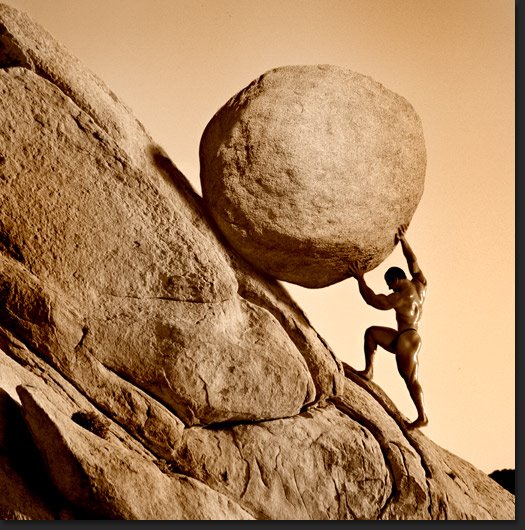
"The struggle itself towards the heights is enough to fill a [wo]man's heart." (No, this is not my lover)


 Posts
Posts


